Automatic lubrication systems help industrial equipment receive the right amount of lubricant at regular intervals without requiring technicians to manually lubricate every lubrication point. In manufacturing plants, mining operations, construction sites, transportation fleets, agriculture, and other demanding industries across the United States and Canada, these systems can support consistent lubrication and simplify maintenance. But how many types of automatic lubrication systems are there? The answer depends on how the systems are classified. The most common types include single-line, dual-line, progressive, and single-point lubrication systems. Some applications also use circulating oil lubrication systems and specialized systems designed for specific machinery.
Understanding how each system works can help maintenance teams select a suitable solution for their equipment, lubricant, operating environment, and number of lubrication points.
Also Read: Automatic Lubrication System Troubleshooting Guide
What Is an Automatic Lubrication System?
An automatic lubrication system delivers grease or oil to selected lubrication points automatically according to a predetermined schedule or operating condition.
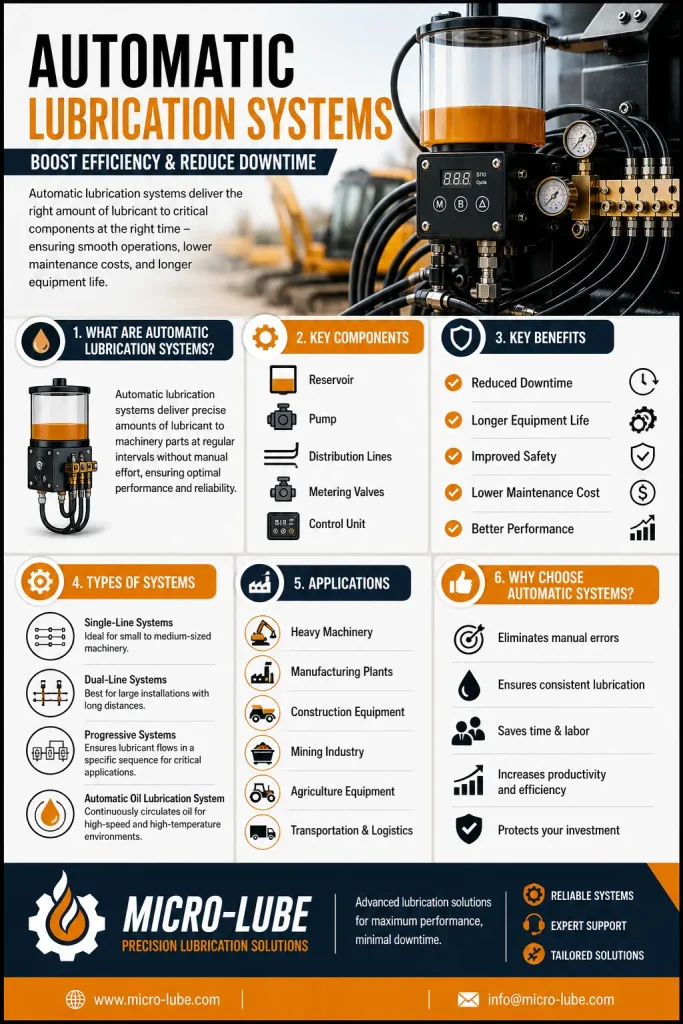
A typical system includes:
- Lubricant reservoir
- Pump
- Controller or timer
- Distribution components
- Metering devices
- Lubrication lines
- Fittings and connection points
Instead of relying on technicians to lubricate each bearing or component manually, the system distributes lubricant through a controlled network.
This approach can be especially useful when equipment has many lubrication points, operates continuously, or works in locations where manual access is difficult.
How Many Types of Automatic Lubrication Systems Are There?
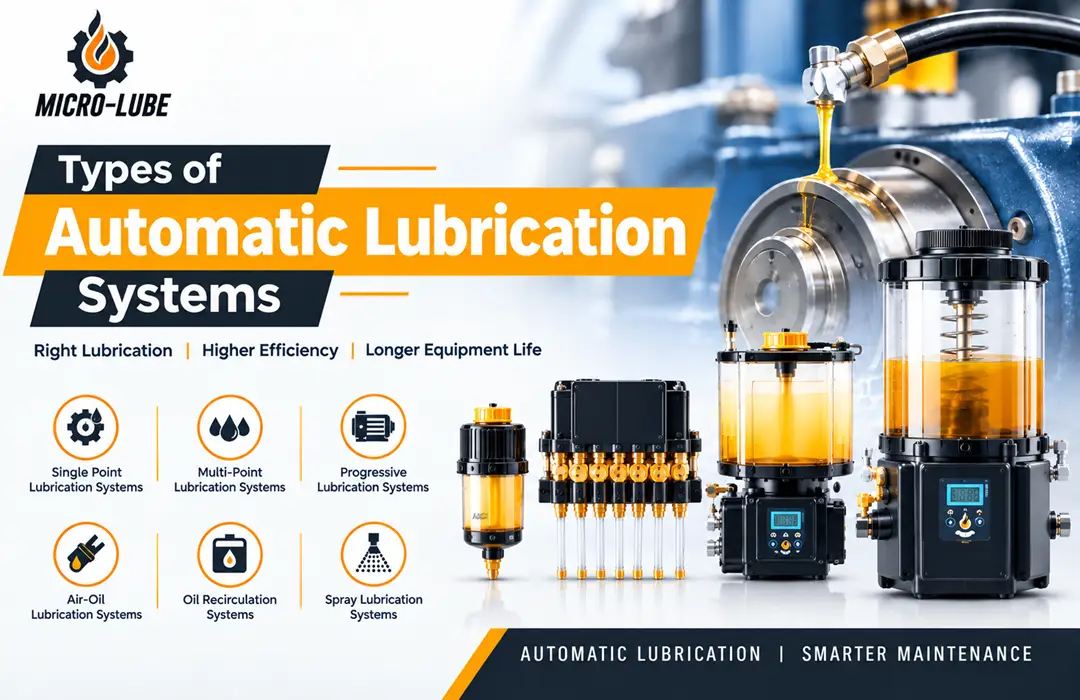
There is no single universal classification, but four major types are commonly used in industrial applications:
- Single-line lubrication systems
- Dual-line lubrication systems
- Progressive lubrication systems
- Single-point lubrication systems
In addition, some industrial applications use circulating oil lubrication systems and specialized oil-air or air-oil systems.
Let’s look at the major types in more detail.
1. Single-Line Automatic Lubrication Systems
A single-line system uses one main supply line to deliver lubricant from the pump to metering devices. The metering devices then provide controlled amounts of lubricant to individual lubrication points.
These systems can work well for machines with relatively simple lubrication requirements.
Common applications
Single-line systems may be used for:
- Manufacturing machinery
- Conveyors
- Machine tools
- Small and medium-sized industrial equipment
- Fans and blowers
- General plant machinery
One advantage is the relatively straightforward system design. Maintenance teams can also configure the system according to the number and location of lubrication points.
2. Dual-Line Automatic Lubrication Systems
Dual-line systems use two main lubricant lines that alternate between supplying lubricant and returning to the pressure cycle.
This design makes dual-line systems suitable for large lubrication networks with many lubrication points.
Where are dual-line systems used?
They are commonly considered for demanding industrial environments such as:
- Steel mills
- Mining equipment
- Cement plants
- Paper mills
- Heavy manufacturing
- Large conveyor systems
- Large industrial machinery
A major benefit is the ability to serve a large number of lubrication points over considerable distances.
For large facilities in the United States and Canada, where equipment may operate continuously in demanding environments, system capacity and reliability are important factors when selecting an automatic lubrication solution.
3. Progressive Automatic Lubrication Systems
Progressive lubrication systems use a series of metering devices to distribute lubricant progressively from one outlet to another.
The lubricant moves through the metering blocks in a predetermined sequence. Each outlet receives a controlled amount of lubricant before the cycle progresses.
Why use a progressive system?
Progressive systems can be useful when an application requires precise lubricant distribution across multiple points.
They are commonly used on:
- Construction equipment
- Mobile equipment
- Agricultural machinery
- Conveyors
- Material-handling equipment
- Industrial machinery
Another useful feature is that some progressive systems can provide monitoring information. If a blockage occurs, the system may stop or indicate an issue, depending on the configuration.
This can help maintenance teams identify lubrication problems before they cause more serious equipment issues.
4. Single-Point Automatic Lubrication Systems
Single-point automatic lubricators are designed to lubricate one lubrication point automatically.
They are often compact and easy to install, making them suitable for bearings and other components that are difficult or inconvenient to access manually.
Common applications
Single-point lubricators can be used for:
- Electric motor bearings
- Fans
- Pumps
- Small gearboxes
- Conveyor bearings
- Blowers
- Other individual lubrication points
They can be particularly useful when manual lubrication would require technicians to repeatedly access elevated, enclosed, hot, or otherwise difficult-to-reach components.
5. Circulating Oil Lubrication Systems
Circulating oil systems are another important category used in industrial applications.
Instead of simply delivering a small quantity of lubricant to a lubrication point, these systems circulate oil through equipment and return it to a reservoir.
The oil can provide lubrication while also helping remove heat from certain components.
Typical applications include:
- High-speed machinery
- Bearings
- Gear systems
- Compressors
- Turbines
- Large industrial equipment
Filtration and oil condition management are important considerations because contaminants can affect both lubricant quality and equipment performance.
Automatic Grease vs. Automatic Oil Lubrication
Automatic lubrication systems generally use either grease or oil, depending on the equipment and application.
| Feature | Automatic Grease | Automatic Oil |
|---|---|---|
| Typical use | Bearings, pins, bushings | Bearings, gears, circulating systems |
| Lubricant consistency | Semi-solid | Liquid |
| Leakage control | Generally easier | Requires suitable containment |
| Cooling capability | Limited | Can provide better heat transfer |
| Common applications | Heavy-duty equipment | High-speed or circulating systems |
The correct lubricant depends on the manufacturer’s specifications, operating temperature, load, speed, and equipment design.
Also Read: Complete Guide Of Automatic Grease Lubrication Systems
What Are the Benefits of Automatic Lubrication Systems?
Automatic lubrication provides several potential maintenance benefits when correctly designed and maintained.
Consistent Lubrication
The system can deliver controlled quantities of lubricant at scheduled intervals. This can help reduce the risk of inconsistent manual lubrication.
Reduced Manual Maintenance
Technicians do not need to manually visit every lubrication point as frequently. This can save maintenance time, particularly on equipment with numerous lubrication points.
Better Access to Difficult Areas
Automatic lubrication can serve components located in areas that are elevated, enclosed, hot, contaminated, or difficult to reach safely.
Reduced Risk of Over-Lubrication
Applying too much lubricant can be as problematic as applying too little. Metering devices can help control lubricant quantities and intervals.
Improved Maintenance Planning
Many modern systems can be integrated with monitoring or control equipment. This can help maintenance teams identify lubrication-related issues and plan service activities.
Also Read: Common Mistakes in Automatic Lubrication Installation
How Do You Choose the Right Automatic Lubrication System?
Choosing a system requires more than simply counting lubrication points. Consider:
Number of Lubrication Points
A single-point lubricator may work for one bearing, while a large centralized system may be more appropriate for equipment with dozens or hundreds of lubrication points.
Lubricant Type
Determine whether the application requires grease, oil, or another approved lubricant.
Operating Environment
Temperature, dust, moisture, vibration, washdown conditions, and outdoor exposure can influence system selection.
This is particularly important for equipment operating in Canadian winters or demanding industrial environments across the United States, where temperature conditions can vary significantly.
Distance Between Components
Large machines may require a system capable of delivering lubricant over longer distances.
Equipment Operating Schedule
Continuously operating equipment may benefit from automatic lubrication because lubrication can occur while the machine follows its normal operating schedule, subject to proper system design and safety procedures.
Monitoring Requirements
For critical equipment, consider whether the lubrication system should provide pressure, level, cycle, or fault monitoring.
Must Read: Automatic Lubrication Systems for Heavy Machinery USA
Automatic Lubrication Systems for U.S. and Canadian Industries
Industries throughout the United States and Canada use automatic lubrication solutions to support equipment maintenance in demanding operating environments.
Applications can include mining, construction, manufacturing, agriculture, transportation, material handling, energy, and industrial processing.
In mining and heavy equipment, automatic lubrication can reduce the need for technicians to manually access multiple lubrication points. In manufacturing plants, centralized systems can help maintain consistent lubrication across production machinery.
Cold-weather operation also deserves attention in Canada and northern U.S. regions. Lubricant viscosity, pump performance, line routing, and component selection should match the expected operating temperatures.
Final Thoughts
So, how many types of automatic lubrication systems are there? The main types include single-line, dual-line, progressive, and single-point systems, while circulating oil and specialized lubrication systems serve additional industrial applications.
The right choice depends on the number of lubrication points, lubricant type, equipment design, operating environment, temperature, distance, and maintenance requirements. A properly designed system can make lubrication more consistent and reduce the amount of routine manual work required from maintenance teams.
For automatic lubrication systems, pumps, dispensing equipment, and fluid-management solutions for industrial applications in the United States and Canada, explore the available solutions from Micro-Lube and contact the company for application-specific guidance.
Frequently Asked Questions
1. What are the main types of automatic lubrication systems?
The main types include single-line, dual-line, progressive, and single-point lubrication systems. Circulating oil systems and specialized oil-air systems are also used for specific industrial applications.
2. Which automatic lubrication system is best for large equipment?
Dual-line or other centralized systems may be suitable for large equipment with many lubrication points. The appropriate choice depends on the equipment layout, lubricant, distances, operating conditions, and number of lubrication points.
3. Can automatic lubrication systems use grease and oil?
Yes. Different automatic lubrication systems are designed for grease, oil, or specific lubricant types. Always select the lubricant and equipment according to the machinery manufacturer’s requirements.
4. Are automatic lubrication systems suitable for mining equipment?
Yes. Automatic lubrication systems can be used on various mining and heavy-duty equipment where numerous lubrication points, difficult access, or demanding operating conditions make manual lubrication challenging.
5. How often should an automatic lubrication system operate?
The operating frequency depends on the equipment, lubricant, load, speed, temperature, and manufacturer’s lubrication requirements. The system should be configured to deliver the required quantity at the appropriate interval rather than using one schedule for every machine.